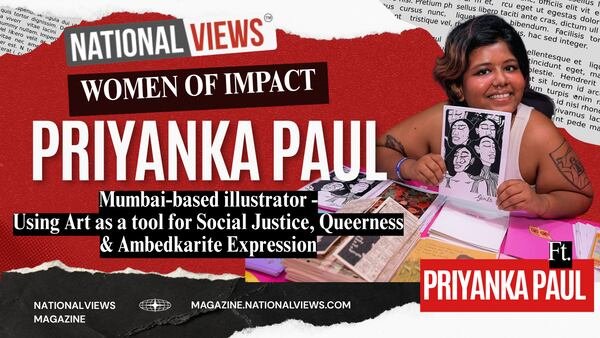
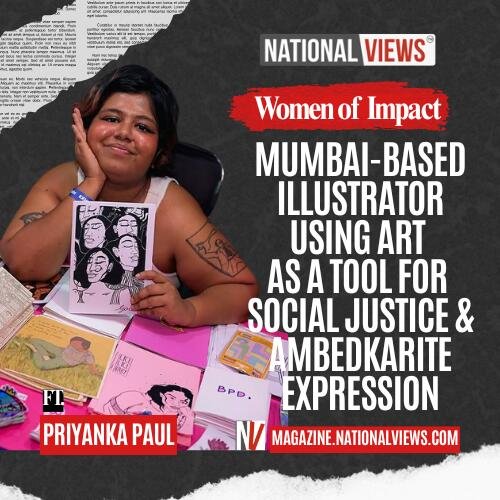
In an era where social media often dilutes meaning into trends, Priyanka Paul has carved a space that is unapologetically political, deeply personal, and artistically disruptive. Based in Mumbai, Priyanka is not just an illustrator—she is a visual storyteller, writer, and art activist, using digital platforms to challenge deeply rooted structures of caste, gender, and identity in India.
Featured in NationalViews – Women of Impact, artist Priyanka Paul represents a new generation of creators who are not merely producing art for aesthetics, but for awareness, resistance, and transformation.
Art as a Language of Resistance
Priyanka’s journey began not as a conventional artist seeking galleries, but as a voice searching for expression. A graduate in Bachelor of Mass Media from St. Xavier’s College, Mumbai, she found her medium in digital illustration—a space where accessibility meets impact.
But what makes her work stand apart is not just the medium—it is the message.
Her art speaks of marginalization, identity, queerness, caste oppression, and body autonomy, often blending humor with discomfort, poetry with protest. Each illustration is layered, urging viewers to pause, reflect, and confront realities that are often ignored.
In a society where silence around such issues is normalized, Priyanka uses color, form, and narrative to break that silence—visually and unapologetically.
The “Goddesses” Series: Reclaiming Power
One of Priyanka Paul’s most defining works is the widely celebrated “Goddesses” series—a bold reinterpretation of Hindu deities.
Instead of passive, idealized figures, her goddesses are powerful, liberated, and real. They bleed, they rage, they exist beyond perfection. Through this series, Priyanka challenges centuries-old narratives that have confined women—and by extension, marginalized identities—into rigid expectations.
This reimagining is not just artistic—it is deeply political.
By reclaiming these symbols, she invites society to rethink how divinity, femininity, and power are defined, especially in a country where mythology and culture are deeply intertwined with social structures.
Intersection of Queerness and Ambedkarite Thought
Priyanka Paul’s work is profoundly influenced by her identity as a queer individual and an Ambedkarite voice. This intersection shapes her perspective, making her art not just expressive, but also educational and activist in nature.
Her illustrations often reflect the teachings of Dr. B.R. Ambedkar, advocating for equality, dignity, and the dismantling of caste hierarchies. At the same time, her work brings visibility to queer experiences—navigating themes of belonging, identity, and acceptance.
What emerges is a unique artistic voice that does not separate identity from activism. Instead, Priyanka merges the two, creating a body of work that is both intimate and revolutionary.
Also Read: Women of Impact: Journalist Kavita Devi Founder of Khabar Lahariya
Artist Priyanka Paul: From Instagram to Global Conversations
While many artists use digital platforms for reach, Priyanka uses them for impact.
Her work has resonated far beyond social media, leading to collaborations with globally recognized organizations such as Gucci, Vogue, Vice, Netflix, and the Malala Fund, along with advocacy groups like the Dalit Human Rights Defenders Network.
These collaborations are not just commercial milestones—they are extensions of her mission to bring conversations around representation, equity, and justice into mainstream spaces.
Priyanka has also taken these conversations to global academic platforms, including speaking at the University of Michigan’s conference on social media and the new political economy, where she addressed digital hierarchies and representation.
Also Read: National Views Women of Impact Supreme Court Lawyer Karuna Nundy
Writing, Healing, and Public Discourse
Beyond illustration, Priyanka Paul is also a writer whose words carry the same intensity as her visuals.
Through contributions to platforms like Mid Day India and The Wire, she explores themes such as anger, mental health, identity struggles, and social change. Her writing often reflects the emotional realities behind activism—the fatigue, the resilience, and the constant negotiation of self in a complex world.
For Priyanka, art is not just a profession—it is catharsis.
It is a way to process lived experiences while simultaneously creating space for others to feel seen and heard.
Recognition and Evolving Influence
Priyanka’s impact has not gone unnoticed. Being featured in the Forbes India Top 100 Digital Stars (2023) and receiving the Cosmopolitan India Feminist Voice of the Year (2020) award are testaments to her growing influence in both digital and cultural spaces.
Her work has also been part of exhibitions like Indianama’s “Reimagining India”, and supported by international art-activism initiatives such as the Wienwoche Festival.
Yet, what defines Priyanka’s journey is not awards—it is the consistency of voice and courage of expression.
Why Artist Priyanka Paul is a NationalViews Woman of Impact
Priyanka Paul represents a shift in how art is created, consumed, and understood. She is not just illustrating ideas—she is challenging systems.
She has:
- Turned digital art into a platform for social justice dialogue
- Amplified marginalized voices through visual storytelling
- Bridged art, activism, and identity in a powerful, accessible way
- Redefined what it means to be a contemporary Indian artist
In doing so, Priyanka is not only influencing audiences—but also inspiring a generation of creators to use their voice with purpose.
The Overall Impact
In a world that often demands conformity, Priyanka Paul chooses courage.
Through bold lines, vibrant colors, and uncompromising narratives, she reminds us that art is not just about beauty—it is about truth, resistance, and change.
Her work stands as a testament to the power of storytelling in shaping a more inclusive and aware society.
And in that journey, Priyanka Paul is not just creating art—
she is creating impact.